In Oakland, Two Greystones on the Same Block Can Be Two Different Deals
August 13, 2026
August 13, 2026
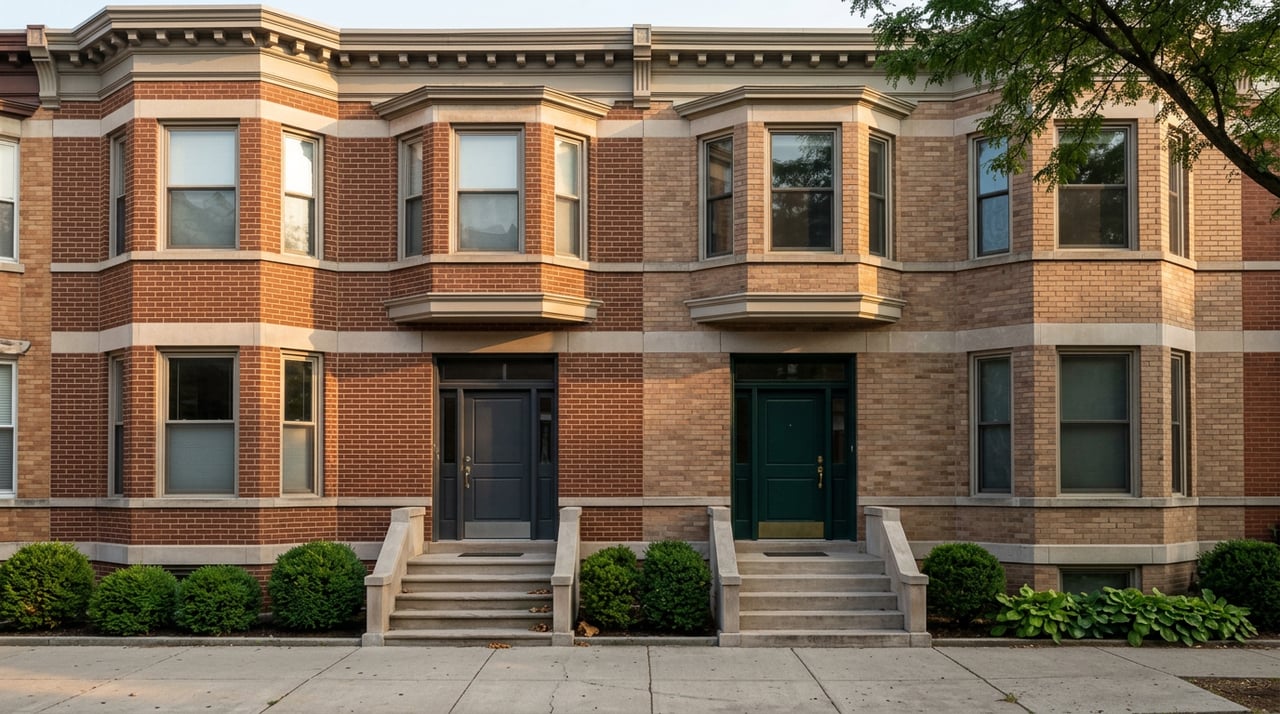
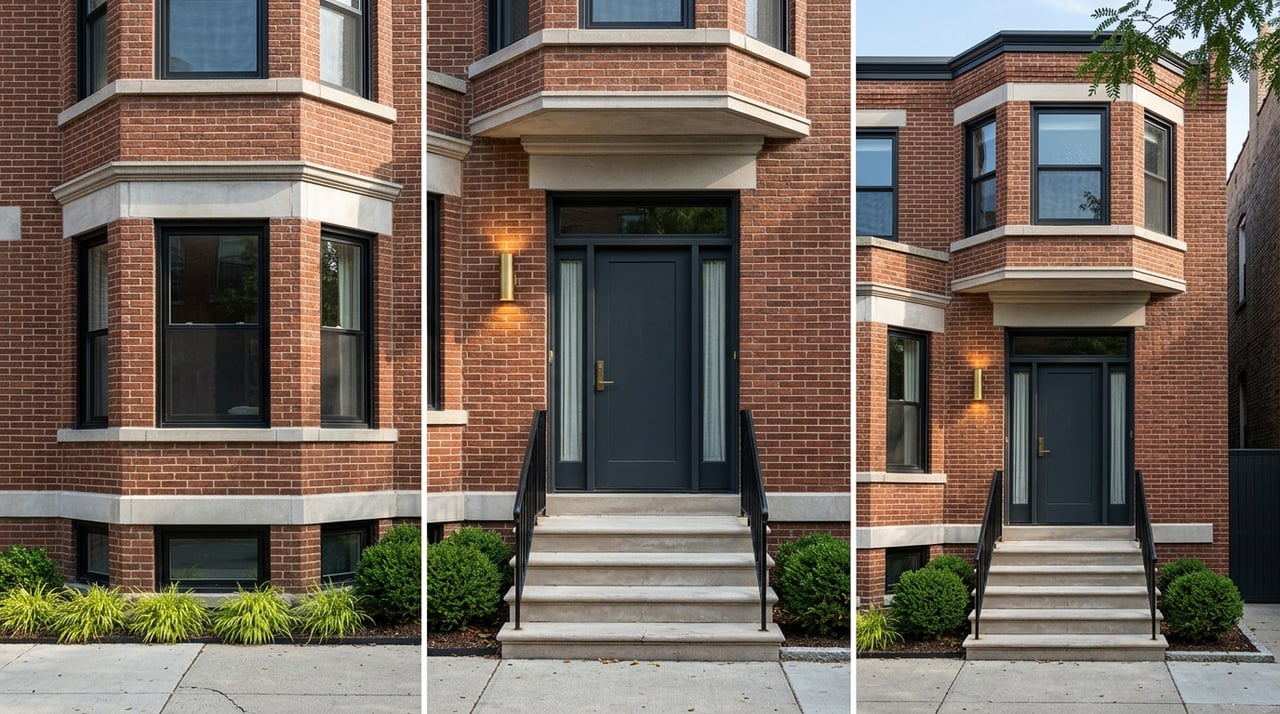
Walk down a residential street in Oakland, Chicago's smallest community area, and you will see the same building twice. Same limestone trim. Same bay window. Same 1890s proportions that made Drexel Boulevard a showcase address when the neighborhood was first platted. One of those buildings is a single-family home you can finance with a standard mortgage. The other, wearing an identical face, is a legal multi-unit building that a residential lender will not touch the same way.
Nothing on the sidewalk tells you which one you are looking at. That is the problem worth understanding before you make an offer.
Oakland's housing stock was built in a tight window, largely between 1872 and 1905, when the area was subdivided and marketed to Chicago's elite. The bones are consistent across the neighborhood: masonry construction, high ceilings, deep lots. What is not consistent is what happened to those bones over the following century. Some houses stayed single-family. Others were carved into flats, rooming units, and small apartment buildings as the neighborhood's population grew through the early twentieth century, and they have stayed that way ever since.
Two recent sales in Oakland make the point better than any statistic. One was a fully renovated three-story Greystone with five bedrooms and three and a half baths, sold as a single-family home on what was described as a landmark block near the lakefront and the 41st Street Pedestrian Bridge. The other closed nearby at 3976 South Ellis Avenue: a condo unit inside an eight-unit residence with a facade styled after the same 1800s Greystone vernacular. Anyone scrolling through both sales back to back could reasonably assume they were shopping in the same category. They were not.
| Single-family Greystone | Multi-unit Greystone-facade building | |
|---|---|---|
| Exterior | Classic 1890s masonry, bay window, limestone trim | Same architectural vernacular |
| Interior configuration | One kitchen, one set of mechanicals, whole-building layout | Multiple separate units, each with its own kitchen and systems |
| Typical financing | Conventional or FHA residential mortgage | Commercial or portfolio multifamily financing once unit count passes four |
| Appraisal comps pulled | Other single-family sales nearby | Income-producing multi-unit sales, often a thinner pool |
| Renovation math | Cost per whole house | Cost per unit, plus vacancy and turnover during work |
Oakland covers just 0.6 square miles, making it the smallest of Chicago's 77 community areas. It was bordered from the start by 35th and 43rd Streets, Cottage Grove Avenue, and Lake Shore Drive, and its earliest residents were industrialists and professionals drawn to Drexel Boulevard's mansions. That did not last. By the close of the nineteenth century the elite had largely moved on, working-class residents moved in, and the Great Migration brought a wave of new residents between 1916 and 1920 that put real pressure on the existing housing stock. The city eventually built the Ida B. Wells Homes between 1939 and 1941, followed by the Clarence Darrow Homes in 1961 and a set of high-rises along Oakenwald and Lake Park Avenues in the early 1960s.
None of that history required tearing down the original mansions. It required using them differently. A single-family house built for one prosperous family in 1895 could hold three or four households with a few interior walls and a second kitchen. That kind of conversion happened across the South Side, and it happened here in a neighborhood small enough that the pattern is dense rather than scattered.
The facade tells you when the building was built. It does not tell you how many kitchens are behind that door.
This is not unique to Oakland. Crain's Chicago Business has documented the same story on the North Side, describing a Lincoln Park greystone built around 1890 that operated as a multiunit apartment building from at least the mid-1950s until a developer bought it in 2006 and converted it back to a single-family home. The direction runs both ways across Chicago. In Oakland, because the original building stock is so uniform in style, the visual signal that would normally tip off a buyer, a newer facade, an obviously chopped-up porch, is often missing entirely.
The practical line in the sand for most residential lenders falls between one and four units. Cross into five or more units in the same building and the loan is no longer underwritten as a home purchase. It becomes a commercial or multifamily transaction, with different down payment expectations, different documentation, and an appraisal based on the building's income rather than on what the house next door sold for.
A buyer who finds a five-bedroom Greystone and an eight-unit Greystone-style building both listed at similar price points per square foot has not found two comparable opportunities. They have found two different asset classes that happen to share a zip code and a roofline. The financing path, the appraisal method, and the exit strategy diverge the moment you get past the front door.
For an investor this distinction is the whole game. A single-family Greystone bought and held will appreciate or depreciate with the neighborhood's residential market. A multi-unit building bought at the same address is priced off its rent roll and its cap rate, which moves on a different clock entirely.
As of early 2026, Oakland's median sale price sits in the neighborhood of $375,000, a figure that blends both categories of building into one number. That median cannot tell you whether a given sale was a single-family home changing hands between owner-occupants or a multi-unit building trading between investors on a cap-rate basis. Both transactions get folded into the same statistic.
That matters most when Oakland gets compared to its immediate neighbors. Kenwood sits directly across Oakland's southern border, with Hyde Park just beyond it, and both carry a longer track record as established, higher-priced markets. Oakland's appeal to a buyer priced out of either has always been architectural similarity at a lower entry cost. But that comparison only holds if you are comparing like buildings. A single-family Greystone in Oakland priced well under what a comparable Kenwood house would cost is a real opportunity. A multi-unit building at the same headline number is a different calculation altogether, one that depends on rents, occupancy, and the cost of bringing aging mechanicals up to code across several units instead of one.
The Obama Presidential Center opened to the public on June 19, 2026, several miles south in Jackson Park. Its presence has put renewed attention on South Side lakefront neighborhoods generally. Whatever effect that has on Oakland specifically will show up first in which category of building sees faster turnover, single-family or multi-unit, and that is a distinction the median price alone will not surface for at least another reporting cycle.
Because Oakland is Chicago's smallest community area, there simply are not many transactions in any given month to smooth out the noise. A handful of Greystone sales, whether single-family or multi-unit, can swing the neighborhood's reported numbers more than they would in a larger community area with hundreds of comparable sales to draw from.
The neighborhood's community institutions reflect the same small, tightly connected footprint. The Kenwood-Oakland Community Organization has spent decades pushing for rehabilitation of the area's older buildings and new construction on formerly vacant lots, work long associated with its leader Robert Lucas. The annual Kenwood-Oakland Parade, led by Shirley Newsome, has served as an informal showcase for that progress, spotlighting rehabbed buildings and new single-family construction alongside each other on the same afternoon. A few blocks away, the Abraham Lincoln Center at 700 East Oakwood Boulevard, designed by Frank Lloyd Wright and founded in 1905, stands as one of the neighborhood's most visible architectural landmarks, now home to Northeastern Illinois University's Center for Inner City Studies.
The lakefront draw is real too. Oakwood, also known as 41st Street Beach, opened in Burnham Park in 2010 and was designed by Muller and Muller architects, earning LEED certification for features including a rainwater harvesting system. The 41st Street Pedestrian Bridge connects the neighborhood directly to that shoreline. None of this changes the underlying financing math on a Greystone, but it explains why buyers keep showing up to compete for a small, fixed supply of buildings that all look remarkably alike from the street.
Is Oakland the same as Kenwood or Bronzeville? No. Oakland is its own official Chicago community area, distinct from both, though it borders Kenwood to the south and sits adjacent to Bronzeville. Many listings describe the area using all three names because of the shared history and proximity, which adds to the confusion buyers already face over building type.
Does a multi-unit Greystone always cost more to finance than a single-family one? Not necessarily more, but differently. Once a building crosses the four-unit threshold, the loan type itself changes from residential to commercial or multifamily underwriting, which comes with its own down payment structure, documentation requirements, and appraisal method based on income rather than comparable sales.
How can I tell if a Greystone I'm considering is legally single-family or multi-unit? The building's exterior will not tell you. You need the city's building record for that specific address and confirmation that the certificate of occupancy matches how the property is being marketed. This is worth doing before you get attached to a listing, not after you're under contract.
If you're weighing a Greystone purchase in Oakland and want to know which side of this line a specific property falls on before you write an offer, Taylor Dixon Group works this exact terrain of South Side multi-family and value-add inventory every week. Reach out for a free home valuation and a straight read on what you're actually buying.
Stay up to date on the latest real estate trends.


Get assistance in determining current property value, crafting a competitive offer, writing and negotiating a contract, and much more. Contact Taylor Dixon Group today to start your home searching journey!