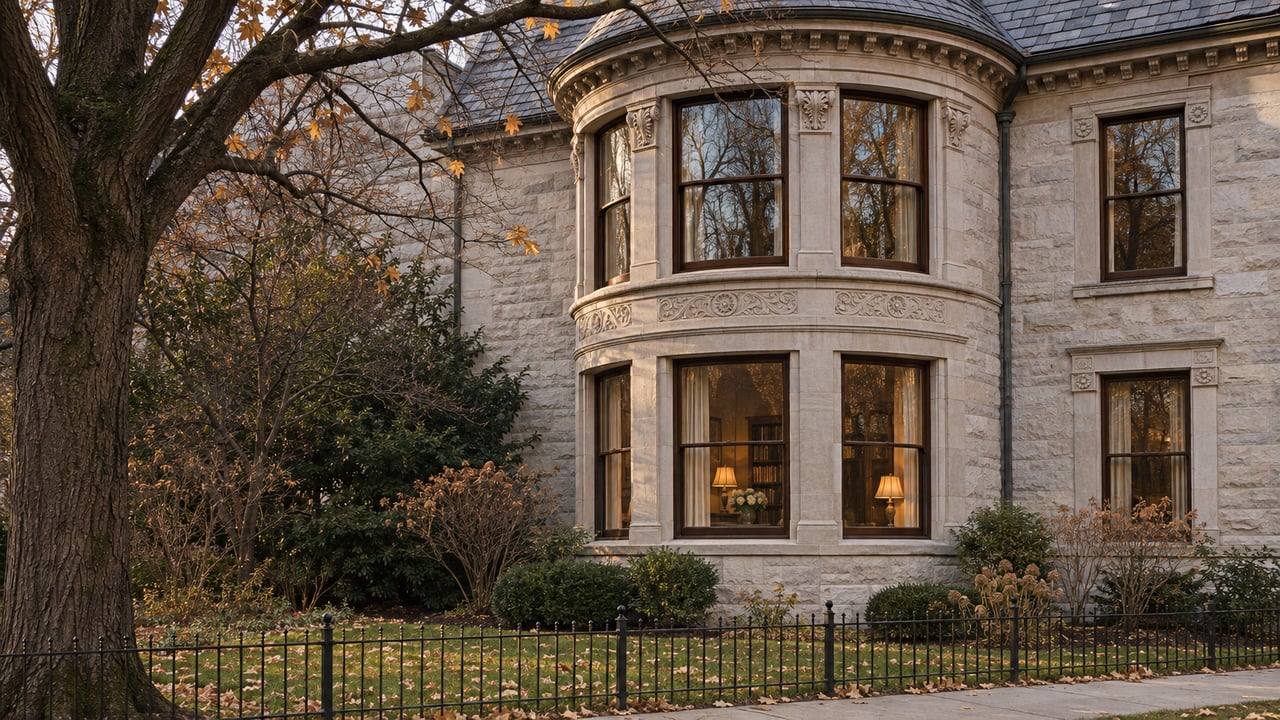
A Kenwood House Walk for Thanksgiving Weekend Guests
November 19, 2026
November 19, 2026
At 47th Street and Lake Park Avenue, guests see a Dunkin' and a pizza counter in a strip of chain storefronts. In 1894, this corner got Kenwood's first commercial building, a block of stores that went up after a streetcar line on 47th Street connected the neighborhood to the city farther west. That history comes from the City's 1978 Kenwood District designation report. The same report says that between 1885 and 1895 Kenwood became the most fashionable neighborhood on the South Side, sometimes called "the Lake Forest of the South Side." Large single-family houses went up from Blackstone to Drexel between 45th and 50th streets.
Those houses are still mostly in a small area. Starting with coffee at Lake Park and ending at the corner of Greenwood Avenue and Hyde Park Boulevard, you can pass two Frank Lloyd Wright houses, three by Howard Van Doren Shaw, a George Maher, a Jarvis Hunt, the house Elijah Muhammad lived in, and a 1924 temple that reopened its sanctuary last December after a three-year restoration. Alfred S. Alschuler designed both a 1908 house on Ellis Avenue and that temple, so the route passes his work twice.
Lake Park Plaza at 1400 E. 47th St. is the practical place to start. The Dunkin' there lists hours of 4 a.m. to 10:45 p.m. on weekdays and 5 a.m. to 10:45 p.m. on weekends. Beggars Pizza, J & J Fish and Charleys are in the same plaza if the group wants lunch afterward. Holiday weekend hours can change, so check before you lead a group there.
If anyone wants open space first, Kenwood Community Park at 1336 E. 49th St. covers 7.01 acres a few blocks south and west of the plaza. From either spot, head toward the 4800 block of South Kenwood Avenue.
The George Blossom House at 4858 S. Kenwood Ave. and the Warren McArthur House at 4852 S. Kenwood Ave. were both built in 1892. Both are private homes, so you see them from the sidewalk. The story behind them is good to tell guests at the curb. According to the Frank Lloyd Wright Trust, Wright took these commissions while he was still under a five-year contract with Louis Sullivan, which the contract did not allow. They are known as his "bootleg houses."
Blossom is nearly symmetrical and Colonial Revival, with Palladian windows spaced evenly across the first floor of the west side and a semicircular conservatory at the back that echoes the columned front porch. McArthur has a dormered gambrel roof and octagonal bays, which the Trust ties to the Queen Anne style and to Joseph Lyman Silsbee, Wright's former employer. McArthur's eldest son, Albert, later apprenticed at Wright's Oak Park studio and designed the Arizona Biltmore Hotel in Phoenix.
Walk west on 48th Street to Woodlawn. The C. S. Bouton House at 4812 S. Woodlawn Ave. is one of Kenwood's oldest houses. Bouton built it for himself in 1873, and the designation report calls it a near-complete example of the Italianate style, with a gently pitched hip roof and eaves on carved brackets and a row of dentils. That is twenty years before the Columbian Exposition in Jackson Park, which the same report credits with driving Kenwood's busiest decade of construction.
Across the street and down the block, 4847 S. Woodlawn Ave. was added to the National Register of Historic Places on March 22, 2022, as the Honorable Elijah Muhammad House. The Hyde Park Herald reported in 2021 that the longtime Nation of Islam leader lived in Kenwood until his death in 1975. The city's Historic Resources Survey lists the house under its original name, the William F. Burrows House, designed by Frost & Granger and built in 1902.
Continue south a short way to see two Howard Van Doren Shaw houses within a block of each other: the Charles Starkweather House at 4901 S. Woodlawn Ave., from 1902, and the Morris Rosenwald House at 4924 S. Woodlawn Ave., from 1903. Shaw's third house on this route is two streets west.
Go back north and west to the top of Greenwood Avenue. The J.J. Dau House at 4807 S. Greenwood Ave. is a George W. Maher design from 1897 that the survey classifies as Prairie. The Richard Nash House at 4841 S. Greenwood Ave., by Pridmore & Stanhope in 1895, is Queen Anne. They were built two years apart on the same block, and they show the shift from Victorian ornament toward the horizontal lines Chicago became known for.
One block west on Ellis is the Gustavus F. Swift Mansion at 4846 S. Ellis Ave., a Renaissance Revival house by Flanders & Zimmerman from 1897. Guests who want stone can walk one more block to Drexel, where the 1978 designation report describes 4851 S. Drexel as a Richardsonian Romanesque house by Treat and Foltz, built in 1887 for Martin Ryerson, one of Kenwood's most prominent residents.
Then walk south on Ellis. The Julius Rosenwald Residence at 4901 S. Ellis Ave. was designed by Nimmons & Fellows in 1903 and is listed in the survey as Prairie. Two blocks down, the David Yondorf House at 5009 S. Ellis Ave. is a 1908 Classical Revival house by Alfred S. Alschuler. Point out Alschuler's name to your guests, because his best-known building is the last stop on this walk.
Turn east toward Greenwood and walk the stretch just north of Hyde Park Boulevard. The Cornelia McLaury House at 4911 S. Greenwood Ave. is Shaw's third house on the route, a Classical Revival design from 1896. The D.F. Bremner House at 5009 S. Greenwood Ave. is from 1899 and was designed by Wilson & Marshall.
Next door, the Homer H. Stillwell House at 5017 S. Greenwood Ave. is by Jarvis Hunt and dates to 1905. In October 2024, Crain's Chicago Business described the exterior in detail: an L-shaped house with an entry cube set into the L, brick quoining on every edge, and a porte cochere built so carriages could drive through to the back of the lot. Crain's also reported that Hunt had designed warehouses for the Butler Bros. mail-order company in 1899, which may be how he came to design this house for the company's president, Homer Stillwell, and his wife, Ellen. That article covered the Archdiocese of Chicago listing the nine-bedroom house for $1.4 million that fall. The porte cochere is the detail to look for from the sidewalk.
The walk ends where Greenwood meets Hyde Park Boulevard, at K.A.M. Isaiah Israel, 1100 E. Hyde Park Blvd. Alschuler designed it in 1924, sixteen years after the Yondorf House, and the City designated it a Chicago Landmark on June 9, 1977. Landmark reports call him the "Temple builder" and describe this building's Byzantine-style walls of polychromatic brick in various shapes, laid in a random pattern. From the corner, the brick is the thing to show guests. Up close, no two stretches of the wall look the same.
The congregation held a ceremony rededicating its restored sanctuary on Sunday, December 14, 2025. The Hyde Park Herald reported that the event marked the end of a three-year restoration that cost more than $5 million. The campaign started in 2021, raised about $5.47 million, and drew contributions from more than 80% of congregants. The largest single piece was a $4.3 million geothermal heating and cooling system, paid for by an anonymous donor, that runs through an underground grid of pipes. The project engineer told the Herald it uses half the energy of a conventional HVAC system. Crews also restored the historic masonry and stained glass, repaired water damage and made the building ADA compliant.
The Herald described the octagonal sanctuary's Guastavino vault, a system of thin arched tiles that Catalan architect Rafael Guastavino brought to the United States and that lets a large room stand without support columns. Rockefeller Chapel on the University of Chicago campus uses the same vaulting along its nave. The same report said the congregation has since received a $250,000 grant from the Chicago Landmarks Commission and $365,000 from the National Fund for Sacred Spaces and the National Park Service's Save America's Treasures program, and that it plans to raise another $2 million for a second phase of work. The history also travels well with guests. According to the Herald, KAM was founded in 1847 as Illinois' first Jewish congregation.
For most people on this walk, the temple is an exterior stop. KAM's website says it welcomes visitors and lists Saturday morning services at 10:15 a.m. Its calendar includes one on November 28, the Saturday of Thanksgiving weekend. The building was also a site in Open House Chicago 2026, the annual festival that opens buildings to the public.
Nearly every stop on this route is a private home, and the stories behind them stay with the houses as owners change. If you own a house in the Kenwood blocks on this walk and want to know what its age, architect and condition mean for its value today, Taylor Dixon Group can help. Our team handles older South Side houses from pre-sale repairs through pricing. Start with a free home valuation, and we'll follow up with a conversation about your specific house.
Stay up to date on the latest real estate trends.
Get assistance in determining current property value, crafting a competitive offer, writing and negotiating a contract, and much more. Contact Taylor Dixon Group today to start your home searching journey!